


Work With
Crafts We
EkiBeki is a social enterprise focused on identification of dying crafts that are on the verge of extinction and revive them through design interventions, skill and capacity building, product development, market development and creating self-governing mechanisms
Glimpses of few of our projects, the unique craft-based products are also available for retail, exports, and corporate gifting
(Click on the images to read more)

Bhil painting
The Bhils live mostly in the states of Madhya Pradesh, Rajasthan, Gujarat, and Maharashtra. Their art is colorful, vibrant, and full of life - and each dot in their painting has deep meaning
Rogan Paintings
Rogan painting, an ancient cloth-printing art from Persia, thrives in Gujarat, India. Utilizing boiled oil and vegetable dyes, artisans apply paint with a metal styluses.


Lippan, Rajasthan
A traditional Indian art form from the Kutch region of Gujarat, known for its intricate mud and mirror work. It involves creating decorative designs on walls using a mixture of clay, often mixed with cow dung or camel dung, and embedding small mirrors within the design.
Pichwai, Rajasthan
Pichwai paintings, rooted in Indian culture, originated in the town of Nathdwara, Rajasthan. These intricate artworks typically depict scenes from Lord Krishna's life, especially his childhood tales. Pichwai paintings are revered for their spiritual and aesthetic appeal

Warli Maharashtra
originating from Maharashtra and Gujarat, is crafted by the ancient Warli tribe. Through simple forms and predominantly white colors, it depicts their lifestyle, customs, and environment.

Banjara Weaving
The Banjaras, especially the women, are dressed in a distinct colorful attire that is both attractive and beautiful. With vivid vibrant colors, beadwork, mirror work and using different assortments, such as bells, shells, tassels etc.

Kalighat West Bengal
Originating in 19th Century near Kolkata's Kalighat temple, Kalighat paintings initially depicted myths, evolving to portray diverse social themes and everyday life in Bengali society.

Golden Grass
Using locally grown all natural and eco-friendly wild grass handcrafted by women of Kendrapara.

Chitrakathi
Chitrakathi is an ancient folk tradition and a unique style of painting that is practiced in Pinguli, a small village in the Sindhudurg district in Maharashtra.

Solapur Wall Hangings
Originating from Solapur, Maharashtra, exemplify the rich textile heritage of the region. They serve as both decorative elements and cultural artifacts, showcasing the craftsmanship of the artisans.

Madhubani
Madhubani paintings have their roots in the Mithila region of Bihar, where they trace back to ancient times. Passed down through generations, this tradition adorned the homes of the region, with women in the village skillfully practicing this art form on their household walls.

Copper enamelling
An age old craft of fusing glass onto the copper surface for color enrichment and lustre known as the art of "Meenakari" in India

The artisans
Dedication. Expertise. Passion.
Three children of artisans have come back to their villages and are working full-time. One of them is even a diploma holder in engineering, and now works as a Chitrakathi artisan.
In another case, the Alibaug copper enameling industry was on the verge of shutting down. However with the children of artisans coming back and learning the required skills from their fathers, the art form has come back to life.
We trained 100+ women in Odisha to be able to utilize the three-four hours that they have in a day. The goal was to help them achieve maximum production while maintaining quality. Creating molds and standard measurement processes helped us achieve this. Due to this, even if the products are made at different places, they are similar but maintain a handcrafted element with little variations between each product.
We introduce you to some of our stars

Choti Tekam
After moving to Bhopal post-marriage, Choti was inspired by the city’s artists and began painting deer, her favourite. Since 2018, she and her husband Santosh have worked with EkiBeki on workshops, products, and the Indore Starbucks wall art.
Gond

Rizwan Khatri
Rizwan, a third-generation Rogan artist. His work has been featured in projects like Starbucks, GES, Pravah (WDC artpiece), and wedding/corporate gifts, with one piece gifted to Japan’s PM by the Indian Government.
Rogan

Vikrant Patil
Meenakari is the art of embellishing metal with vibrant glass and fine wires. Sanjay Patil is among the few continuing this craft in Alibag, creating jewellery, home décor, and festive accessories, with projects like Starbucks, Mumbai.
Copper Enamelling

Rupsona Chitrakar
Kalighat
Rupsona from Maya, West Bengal, learnt her craft from her grandmother and father. Drawn to art since childhood, she uses natural colours to depict folk songs and stories. She has worked on stationery products and projects like GES.

Rabari craft
From threading needles at 16 to mastering Rabari craft, Karmiben is stiching her way to a vibrant future rooted in tradition. Joined somaya vidhya in 2024 to improve her skills in the sector and grow the business

Karmiben
Chetan Gangavane
Chitrakathi
A miniature artist traditionally from Bhilwara, Rajasthan and now resides in Udaipur. He learnt the art from his maternal grandfather and his forefathers had been indulged in the art form since generations.

Dhuli KATARA, Managing four children and a flourishing art practice, Dhuli paints daily and draws inspiration from everyday life and nature. Her bright color palette and playful animal motifs bring freshness to Bhil tradition.
Bhill
Dhuli Katara

Rohit Rathod
Banjara embroidery
Rohit Shankar Rathod* is a 22-year-old Banjara embroidery entrepreneur from Beed, Maharashtra. For the past four years, he has been immersed in the craft, inspired by his mother, who sold to the Banjara community market, and his grandmother, who practiced the art

Manikchand
Shohrai

Manikchand Mahto, at 33, stands as a third-generation artist, drawing inspiration from the rich artistic heritage passed down by his mother, a master artisan. Unlike formal training, Manikchand’s artistic journey unfolded through keen observation and learning by seeing, a testament to his inherent talent and familial influence.
From discovering bulrush weaving in school to turning it into a livelihood for women in his village, Sahana’s story is about innovation rooted in tradition. Her work through Sahana Reed & Leather is not just craft - it’s community, skill-building and self-reliance in action.
Grass weaving
Sahana Satapute
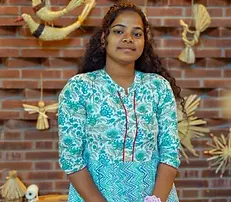
Chandana Srinath
Ikkat weaving
At the heart of the brand today is Chandana Srinath, the current head‑weaver and owner. She took over from her father, Late Edem Srinath Garu, an award‑winning master weaver, and continues to lead a team of 40–50 skilled artisans

Gobindo Halder
Sholapith
Gobindo Haldar belongs to a village on the outskirts of Kolkata. He is one of the few remaining exponents of art to use this spongey water plant growing in marshy land in Orissa, Assam and Bengal to create beautiful sustainable sholapith flowers

The Verma family of Braj is the only one who carries on the legacy of this art. Ashutosh Verma, the sixth-generation artist most importantly states that Sanjhi is not stenciling or rangoli art. It is a highly skilled craft of paper cutting.
Sanjhi - Paper cutting craft
Ashutosh Verma

jahangir Bhatt
Crewel Embroidery
Jahangir’s entire family has been working as artisans in various craft techniques such as weaving and hand embroidery. Jahangir himself is an artisan and has graduated from the Craft Development Institute. 10 years back Jahangir started his own enterprise (The Crewel).

Six Brothers
Glass Craft
6 Brothers Glass Craft, founded by Vishal Kumar, stands as a testament to the enduring legacy of glass craftsmanship. As the third generation in his family deeply rooted in the intricate art of glasswork, Vishal brings a contemporary vision to this traditional craft.

PS- The imagery used across our website draws from authentic Indian art traditions, where every motif carries meaning and history.
-
A scene of a mother crocodile guiding her baby through water, the lion, the dragons, all come from the storytelling tradition of Bhil art, known for its vibrant colours, dotted textures, and intricate patterns.
-
You will also notice the presence of the peacock, inspired by Pichwai painting - a devotional art form that originated over 400 years ago in Rajasthan.
-
You can spot Chitrakathi borders, that we also used on our stationery, the artisan earns royalty from all we sell.
-
The lotus used are on our copper enamel wall plates, and of course, the ए is from our logo in its devnagiri form.
-
By drawing from these living traditions, we aim to ensure that the visuals used carries forward the stories, symbolism, and heritage of India’s craft communities.


